[CHARTERING · VOYAGE ESTIMATION
]
Which ship should take this cargo?
One ship is closer to the load port. Another gives you more room on the dates. Shipnet lets chartering teams compare open vessels against the same cargo order, using the voyage schedule operations works from.
Shipnet's new web-based commercial and accounting platform

Compare the ships before you fix
From planning to final reporting, every stage of the voyage flows through one connected system.
Start with the broker’s email
Shipnet’s AI Inbox pulls cargo details from the email and its attachments. Check them against the original message, then open a Quick Estimate using the latest vessel positions and expected opening dates.
See which ships make the laycan
Run the same cargo against your open ships. Compare the expected net result, time charter equivalent (TCE), laycan fit and estimated CO₂ side by side.
Carry the fixed estimate into the voyage
Build out the estimate with laytime terms, the bunker plan and applicable EU ETS and FuelEU costs. Once you fix, operations takes over the voyage with the figures it was fixed on.
Let's take a look at an example ...
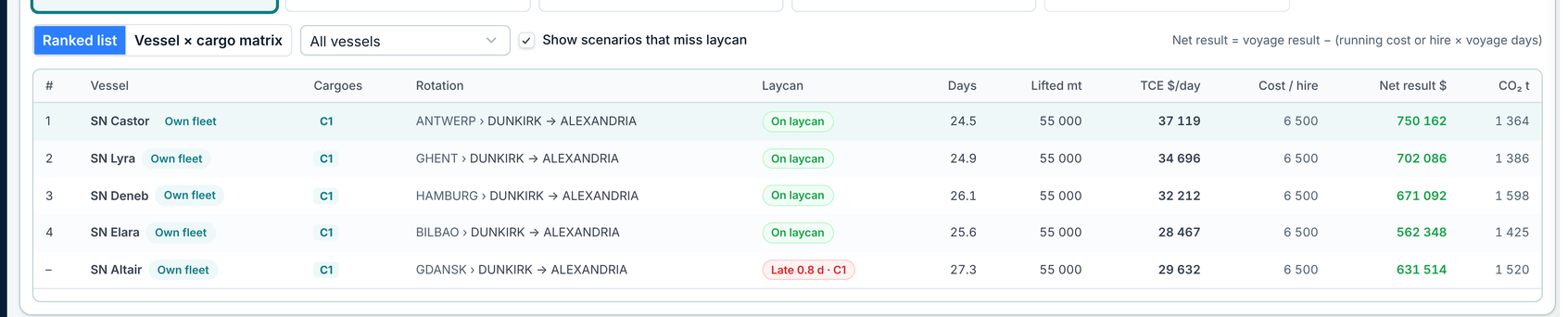
One cargo, five open ships, compared on the same terms.
Bring a cargo you’d price against more than one ship
Bring a dry bulk or tanker example to a session with a Shipnet product specialist.
We’ll show how the broker’s order becomes an estimate, how the vessel options compare and what carries through when you fix.
Tanker orders quoted in Worldscale can go through the same workflow.
[the difference]
Most enterprise software forces you to adapt your operations to fit the system.
Shipnet was designed the other way around - shaped by how shipping companies actually run fleets.
Shipnet brings technical, commercial and financial operations into one connected environment - so teams can run vessels with confidence, not workarounds.
[why shipnet]
Software that understands shipping
Designed alongside shipowners and operators over more than 30 years, the platform reflects the realities of modern shipping: complex workflows, regulatory pressure, and the constant movement between ship and shore.
Rather than forcing teams to adapt around disconnected systems, Shipnet is built to support the way maritime operations run in practice.
Technical, commercial and financial workflows connected — not siloed
Operational insight that supports decisions in the moment, not after the fact
Proven across global fleets through regulatory change and operational complexity
Trusted by shipping companies for dependable operational control in the reality of running vessels, people and cargo at sea.
How Shipnet supports your role
When information flows across the organisation, decision-making becomes simpler.
[Commercial teams]
Plan and monitor voyages with operational and financial data aligned in real time.
[Finance teams]
Reduce reconciliation effort through accounting built around fleet activity.
[Executives]
Gain a clear, organisation-wide view of operational performance and profitability.
150+ Customers
30+ Years in maritime software
31 Countries
[Commercial teams]
Plan and monitor voyages with operational and financial data aligned in real time.
[Finance teams]
Reduce reconciliation
effort through
accounting built around fleet activity.
Some of our customers





150+
Customers
30+ Years
in maritime software
31
Countries
See Shipnet in your operation
Understand how an integrated maritime
ERP platform fits your fleet -
based on how you actually work.
Talk through your setup
See Shipnet in your operation
Understand how an integrated maritime ERP platform fits your fleet - based on how you actually work.
Talk through your setup